Minimalist Desk Cable Management: Complete Routing Blueprint and Hardware Guide
Pull any so-called minimalist desk setup thirty inches away from the wall and the illusion collapses. Behind the walnut top...
Finding the best mechanical keyboard switches for a shared office comes down to choosing between silent tactiles and lubricated linears. While silent tactiles use stem dampeners to muffle bottom-out noise without sacrificing feedback, lubricated linears eliminate spring ping and rail friction. Explore key technical specifications and practical guidance for a quiet, ergonomic typing setup.
Silent tactile and lubricated linear switches offer distinct solutions for reducing mechanical keyboard noise in office settings. Silent tactiles feature stem dampeners that physically suppress bottom-out and top-out impact sounds while retaining tactile feedback. This design helps touch-typists avoid bottoming out without generating sharp transients.
Lubricated linear switches eliminate mid-stroke friction and spring resonance, providing a smooth typing experience, but they lack physical dampeners. While lubricated linears operate quieter than stock linears, silent tactiles remain the quieter option. Proper lubrication technique and switch selection are key to controlling overall acoustic levels.
Editorial Disclosure: At Setuplix, we independently review and test desk gear. When you purchase through our vetted links, we may earn an affiliate commission at no extra cost to you.
Somewhere around 2:47 PM the office gets quiet enough that you can hear it: the hollow tock of a mechanical keyboard bottoming out three desks over. It is not loud in absolute terms. It is loud in relative terms, and relative is what gets you moved to a different pod. The same physics that makes a mechanical board feel so much better than a membrane slab — real travel, real actuation, real feedback — is also what broadcasts your typing cadence to everyone within eight meters.
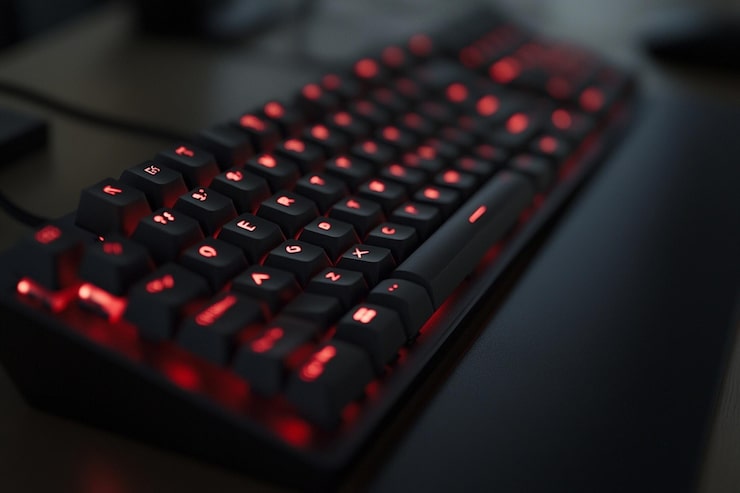
The fix is not to retreat to a rubber dome. The fix is switch selection, and for office productivity there are two credible answers: silent tactile switches and lubricated linear switches. They attack the same problem from opposite directions, and choosing wrong costs you either your tactile feedback or your noise budget. Here is what actually changes when you install each one, measured against published datasheets rather than forum folklore.
A mechanical keyboard generates sound at four distinct moments: the downstroke as the stem travels, the bottom-out when the stem slams into the housing floor, the top-out when the spring pushes the stem back against the upper housing, and the return of the keycap against the switch. Clicky switches add a fifth — a deliberate metal-on-metal click mechanism — which is why they are disqualified from shared workspaces before the conversation starts.
Silent tactile and lubricated linear switches intervene at different points in that chain. Silent tactiles attack the bottom-out and top-out events directly with rubber or silicone dampeners moulded onto the stem. Lubricated linears attack friction and spring resonance, which reduces the high-frequency content of the downstroke and eliminates the metallic ping that stock springs produce. Neither one is a complete solution on its own, and understanding which noise you are actually fighting is the entire game.
There is also a standards dimension most buyers ignore. ISO 9241-410 sets out design criteria for physical input devices, including key travel, actuation force and tactile feedback characteristics [^6]. ANSI/HFES 100-2007 goes further and specifies how the input device should be positioned relative to the operator [^7]. A switch that feels superb in a five-minute showroom test can violate both documents in practice if the force curve fights your finger across a full workday.
A silent tactile switch is a standard tactile switch with dampening material added to the stem. Cherry MX Silent Red, for example, is rated at 45 cN actuation with 1.9 mm pre-travel and 3.7 mm total travel — note that the total travel is 0.3 mm shorter than a standard MX Red, because the dampener physically occupies part of the stroke [^1]. That reduction is the tell. If a silent switch spec sheet lists 4.0 mm total travel, the dampening is either minimal or the figure is marketing.
Two approaches dominate. The first is integrated stem dampening, used by Cherry in its Silent line and by Kailh in its BOX Silent series. Kailh BOX Silent Brown runs approximately 45 cN actuation with 1.8 mm pre-travel and 3.6 mm total travel [^3]. The dampener is part of the stem moulding, which keeps the switch serviceable and consistent across a production run.
The second approach is silicone dampening on an otherwise conventional stem, used by Gazzew in the Boba U4 and by Zeal PC in the Zilent V2 line. Boba U4 ships in 62 g and 68 g bottom-out variants [^4]; Zilent V2 ships in 62 g, 65 g, 67 g and 78 g [^5]. These are enthusiast-grade switches with tighter tolerances and a noticeably more refined bump than mass-market silent tactiles, and they cost accordingly.
The practical result is a switch that still tells your fingers when it has actuated, but truncates the impact noise at both ends of the stroke. For touch-typists who rely on that bump to avoid bottoming out, this is the single highest-leverage upgrade available.
Silent tactiles are not silent. They are quiet. The dampener removes the sharp transient, but the housing still resonates, the keycap still returns, and the plate still transmits vibration into the case. On a stiff aluminium plate in a hollow tray-mount case, a silent tactile can still measure louder than a well-damped linear in a gasket-mounted board. The switch is one variable in a system.
The second limitation is feel. Dampeners add a slightly cushioned, almost mushy quality to the bottom-out that some typists find imprecise. If you type with heavy bottom-out force, you will feel the dampener on every keystroke. If you type lightly and float above the actuation point, you will barely notice it.
Linear switches have no tactile bump. The stroke is a single uninterrupted travel from rest to bottom-out, which makes them fast and predictable for high-volume typing. The problem is that a stock linear is also the noisiest switch type in the mid-stroke, because every bit of friction between stem and housing rail becomes audible vibration, and every spring has a resonant frequency that shows up as a metallic ping.
Lubrication does three things. It reduces friction between the stem rails and the housing, which smooths the stroke. It damps spring resonance, which removes the ping. And it slightly increases the perceived weight of the switch by adding viscous resistance, which is why a 50 cN linear can feel like a 55 cN linear after a heavy application.
The chemistry matters. Krytox GPL 205 Grade 0 is a PFPE grease with high viscosity and excellent plastic compatibility, and it is the standard choice for linear sliders and housing rails [^10]. TriboSys 3203 and 3204 are lighter greases used where you want smoothness without the drag — most commonly on tactile stems, where a heavy grease on the legs would deaden the bump entirely [^10].
Gateron Yellow is a useful reference point for the linear category: approximately 50 cN actuation, 2.0 mm pre-travel, 4.0 mm total travel [^2]. It is the switch most often recommended as a first lubrication project because the improvement is dramatic and the failure mode is forgiving.
The most common mistake in this entire category is applying Krytox 205g0 to a tactile switch. The grease migrates onto the tactile legs, fills the bump, and converts a tactile switch into a heavy, sluggish linear. If you want a lubricated tactile, use TriboSys 3203 or 3204, apply it sparingly to the rails and the spring only, and leave the legs dry. You can always add more. You cannot easily remove it.
The second mistake is over-lubrication. A switch that has been packed with grease will feel sticky on the upstroke, will attract dust, and will lose consistency across the board as the excess migrates. Thin, even application beats volume every time.
The table below compares published manufacturer figures for the switches most commonly deployed in office builds. Where a manufacturer publishes only bottom-out weight, that is noted. Figures are datasheet values, not bench measurements.
| Switch | Type | Actuation Force | Pre-Travel | Total Travel | Dampening | Office Fit |
|---|---|---|---|---|---|---|
| Cherry MX Silent Red | Linear | 45 cN | 1.9 mm | 3.7 mm | Integrated stem | Excellent |
| Cherry MX Silent Black | Linear | 60 cN | 1.9 mm | 3.7 mm | Integrated stem | Good |
| Cherry MX Red | Linear | 45 cN | 2.0 mm | 4.0 mm | None | Moderate |
| Gateron Yellow | Linear | ~50 cN | 2.0 mm | 4.0 mm | None | Moderate |
| Cherry MX Brown | Tactile | 55 cN | 2.0 mm | 4.0 mm | None | Moderate |
| Kailh BOX Silent Brown | Tactile | ~45 cN | 1.8 mm | 3.6 mm | Integrated stem | Excellent |
| Gazzew Boba U4 | Silent tactile | 62 g / 68 g bottom-out | ~2.0 mm | 4.0 mm | Silicone stem | Excellent |
| Zeal PC Zilent V2 | Silent tactile | 62 / 65 / 67 / 78 g bottom-out | ~2.0 mm | 4.0 mm | Silicone stem | Excellent |

Last Updated: November 14, 2026