Top Dual-Motor Electric Standing Desks Tested for Stability and Zero Wobble
Editorial Disclosure: At Setuplix, we independently review and test desk gear. When you purchase through our vetted links, we may earn an affiliate commission at no extra cost to you. Push any standing desk to its top height, clamp a 32-inch display to a gas-spring monitor arm, and give the front edge a firm nudge. […]
Editorial Disclosure: At Setuplix, we independently review and test desk gear. When you purchase through our vetted links, we may earn an affiliate commission at no extra cost to you.
Push any standing desk to its top height, clamp a 32-inch display to a gas-spring monitor arm, and give the front edge a firm nudge. What happens in the next two seconds tells you more about that desk than its entire spec sheet. The desktop does not simply move — it oscillates. Front-to-back pitch, side-to-side sway, and a rotational twist that shows up as a monitor that will not stop nodding. That oscillation is the single most common complaint we hear from readers who finally bought a sit-stand desk and immediately regretted it.
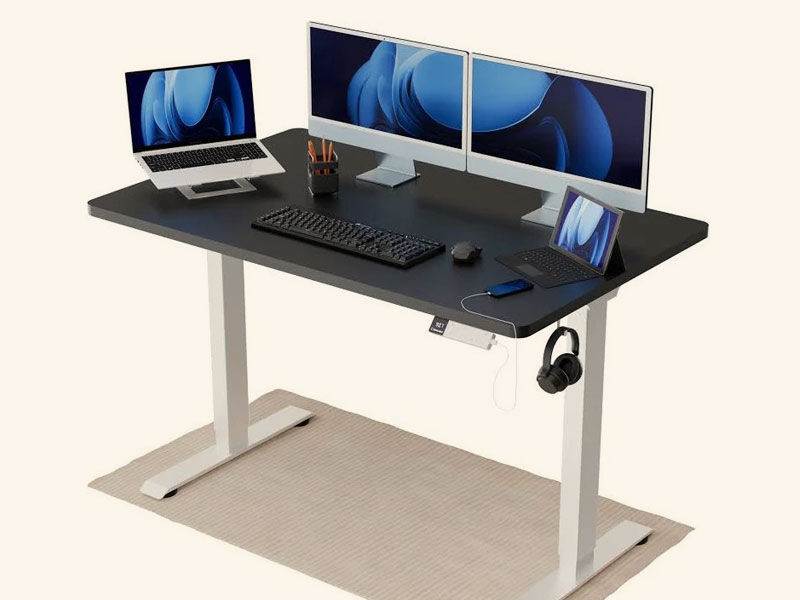
Almost all of them bought on the wrong spec. They compared load ratings and height ranges, then discovered that a 265 lb capacity says nothing about lateral rigidity at 48 inches. The variable that actually governs wobble is lift architecture: how many motors, how many telescoping stages, how much column overlap survives at full extension, and how rigidly the frame ties the legs together. Get those four right and the desk disappears under you. Get them wrong and you will be shopping again within a year.
Key Takeaways
- Dual-motor drive is the baseline for a stable sit-stand desk, but motor count alone does not eliminate wobble — frame geometry does.
- Three-stage telescoping columns outperform two-stage columns of identical material because they retain more tube overlap at full height.
- Rotational twist is the hardest motion mode to kill; only a four-leg frame meaningfully solves it.
- Column overlap at maximum height predicts wobble better than rated load capacity does.
- Certification to ANSI/BIFMA X5.5 or EN 527-2 is a floor, not a guarantee — neither standard simulates a heavy monitor arm at 48 inches.
- Foot width, floor coupling, and desktop mass are the three cheapest stability upgrades available after purchase.
Why Dual-Motor Architecture Is the Baseline for a Wobble-Free Desk
A single-motor desk drives one leg and relies on a driveshaft to turn the opposite leg’s screw. That works — until the shaft develops torsional flex under load, at which point the two sides desynchronize by a few millimeters and the desktop tilts. You feel it as a subtle rocking when you lean on one corner, and you feel it again every time the desk starts and stops.
A dual-motor system puts an independent motor in each leg, coordinated by a control box that reads position feedback from both columns and corrects drift in real time. The practical results are faster travel speed, higher rated load, smoother start and stop ramps, and — critically — a desktop that stays level when you shift weight from one side to the other.
The physics of lateral sway at standing height
Wobble is a stiffness problem, and stiffness scales badly with height. Every telescoping column is a cantilever. As the inner tube extends, the overlap between inner and outer tube shrinks, and the effective bending stiffness of that joint falls off sharply with the unsupported length. A desk that feels rock-solid at 29 inches can feel like a diving board at 48. This is precisely why a three-stage column — which uses three nested tubes to reach the same height with more retained overlap — almost always outperforms a two-stage column of identical material and wall thickness.
There are three distinct motion modes to test for, and they fail independently of one another:
- Front-to-back pitch — the desk nods toward and away from you. Driven by column bending and by the rigidity of the foot-to-column joint.
- Lateral sway — side-to-side translation. Governed by the crossbeam, the foot width, and how well the feet couple to the floor.
- Rotational twist — one corner lifts while the opposite drops. The most damaging mode for monitor arms, and the hardest to eliminate without a four-leg frame.
What the second motor actually buys you
Beyond symmetry, the second motor changes the duty cycle math. Two motors sharing the load run cooler and quieter than one motor doing all the work, which matters if you are changing posture eight to twelve times a day. It also enables meaningful anti-collision sensitivity: with independent position feedback per column, the controller can detect an obstruction on one side and stop or reverse before the desktop racks. On a single-motor desk, the driveshaft masks that signal.
What the second motor does not buy you is lateral rigidity. Two motors bolted to a flimsy two-stage frame still wobble. Motor count is a prerequisite, not a solution.
How Setuplix Tests for Stability and Zero Wobble
We do not grade desks by shaking them and forming an impression. Every unit that comes through the shop runs the same protocol, in the same order, on the same floor.
The Setuplix wobble protocol
- Height ladder. The desk is measured at 28, 36, 42, and its maximum height. Most desks pass at 28 and fail at max — the useful data is where the transition happens.
- Static displacement. A dial indicator is fixtured to a rigid reference frame and touched to the desktop edge. We apply a 10 lb horizontal force at the front edge, then at the side edge, and record peak displacement in millimeters.
- Decay time. The desk is struck with a calibrated impulse and we time how long the oscillation takes to fall below the noise floor. A stiff desk rings for under a second; a wobbly one keeps going for three or more.
- Loaded condition. The full protocol repeats with the desk loaded to roughly 60 percent of rated capacity, distributed the way a real workstation is — monitor arm clamped at the rear, CPU or drawer unit on one side.
- Cycle and thermal. Two hundred full-travel cycles at rated load, logging motor temperature, travel-time drift, and audible output in decibels at one meter.
We also measure the number buyers never ask about: column overlap at maximum height. Extend the desk fully, then measure how much of the inner tube is still captured inside the outer tube. Below roughly 20 percent overlap, that joint becomes the dominant source of pitch. This single figure predicts wobble better than any marketing spec on the box.
Why the standards are a floor, not a ceiling
ANSI/BIFMA X5.5 covers desk and table products and includes stability and cyclic load testing [^1]. EN 527-2 sets safety requirements for office work tables, with EN 527-1 covering dimensions [^2]. Passing them is table stakes. Neither standard simulates a 34-inch ultrawide on a gas-spring monitor arm at 48 inches of height — which is exactly the configuration that generates the complaints. Our protocol is deliberately harsher than the certification floor, and we report the gap.
Technical Specifications Comparison: Dual-Motor Desk Classes
Rather than rank individual SKUs — spec sheets change quarterly and regional variants differ — here is how the four dual-motor configurations actually behave on the bench. Ranges reflect the class, not a single product. Verify the current spec sheet before you buy.
| Configuration | Lift architecture | Typical height range | Rated load | Column stages | Footprint (W x D) | Setuplix wobble index* | Best for |
|---|---|---|---|---|---|---|---|
| 2-leg, 2-stage dual motor | One motor per leg, synchronized control box | 28–47 in | 150–200 lb | 2 | ~43 x 24 in | 6.5 / 10 | Seated-dominant users, light loads |
| 2-leg, 3-stage dual motor | One motor per leg, three nested tubes | 24–50 in | 220–300 lb | 3 | ~47 x 27 in | 3.5 / 10 | The default recommendation for most setups |
| 3-leg / L-shape dual motor | Two motors driving three columns | 24–50 in | 300–350 lb | 3 | ~63 x 30 in | 3.0 / 10 | Corner workstations, dual-monitor arrays |
| 4-leg dual motor (paired) | Two motors per side, four columns | 24–50 in | 350–440 lb | 3 | ~60 x 30 in | 1.5 / 10 | Heavy monitor arms, drafting, shared benches |
*Setuplix wobble index: a composite of static displacement, impulse decay time, and rotational twist measured at maximum height, normalized 1–10 where lower is stiffer. Class averages from our bench, not manufacturer figures.
Read that table by column, not by row. The jump from two-stage to three-stage is the largest single improvement available to you. The jump from two legs to four is the second largest, and it is the only one that meaningfully fixes rotational twist.
Follow us on Twitter/X
Best Work From Home Setup 2026: 6 Essential Desk Accessories for Maximum Productivity

Last Updated: November 7, 2026